

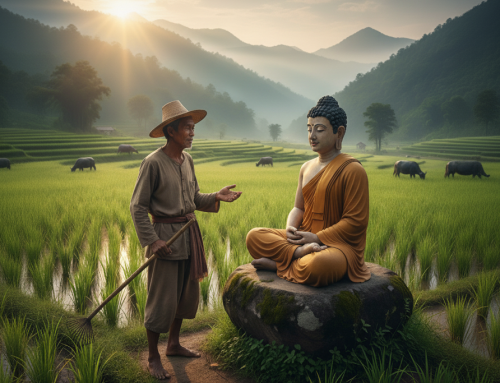
His Holiness Hui Neng, who became the great Sixth Patriarch of Ch’an (Japanese Zen) was a poor illiterate peasant boy from Hsin Chou of Kwangtung. One day, after he had delivered firewood to a shop, he overheard a man reciting the following line from the “Diamond Sutra” – “Depending upon no-thing, you must find your own mind.” Instantly, Hui Neng became Enlightened. The full verse said: “All Bodhisattvas (Compassionate Ones) should develop a pure mind which clings to no-thing whatsoever; and so he should establish it.”
The man who recited this sutra encouraged Hui Neng to meet the Fifth Zen Patriarch, Hung Jen, at the Tung Chian Monastery in the Huang Mei District of Chi Chou. Hui Neng said to the Fifth Patriarch: “I am a commoner from Hsin Chou Kwangtung (today, near Canton in the south of China). I have traveled far to pay you respect, and I ask for nothing but Buddhahood.” “You are a native of Kwangtung, a barbarian? How can you expect to be a Buddha?” asked the Patriarch. “Although there are northern men and southern men, north and south make no difference to their Buddha Nature. A barbarian is different from Your Holiness physically, but there is no difference in our Buddha Nature.” Master Hung Jen immediately accepted Hui Neng as his disciple, but he had to hide this fact from the very educated northern monks at the monastery. At the time of the Fifth Patriarch, Ch’an was still influenced by Indian Buddhism, which did not emphasize direct awakening, but the importance of study and metaphysical debates. To protect Hui Neng, the Patriarch sent him to the kitchen to split firewood and pound rice for eight months.
One day the Fifth Patriarch told his monks to express their wisdom in a poem. Whoever had true realization of his original nature (Buddha Nature) would be ordained the Sixth Patriarch. The head monk, Shen Hsiu, was the most learned, and wrote the following:
The body is the wisdom-tree,
The mind is a bright mirror in a stand;
Take care to wipe it all the time,
And allow no dust to cling.
The poem was praised, but The Fifth Patriarch knew that Shen Hsiu had not yet found his original nature, on the other hand, Hui Neng couldn’t even write, so someone had to write down his poem, which read:
Fundamentally no wisdom-tree exists,
Nor the stand of a mirror bright.
Since all is empty from the beginning,
Where can the dust alight
The Fifth Patriarch pretended that he wasn’t impressed with this poem either, but in the middle of the night he summoned Hui Neng. The Fifth Patriarch gave him the insignia of his office, the Patriarch’s robe and bowl (source). Hui Neng was told to leave for the South and to hide his enlightenment and understanding until the proper time arrives for him to propagate the Dharma.
“A special transmission outside the scriptures,
Not dependent upon words and letters;
Direct pointing to the human mind,
Seeing into one’s true nature, and attaining Buddhahood.”
This four-line passage is attributed to Bodhidharma, a fifth or sixth-century C.E. semi-legendary Buddhist monk. This passage seems to explain why Hui Neng was chosen as the Sixth Patriarch, while Shen Hsiu was regarded as the top scholar. The Fifth Patriarch realized that Hui Neng had a deeper connection to the Dharma. Transmission from teacher to student, or from one patriarch to the next, is not based on scholarly accomplishments, but rather is based on the Dharma having reached deep into the marrow of the bones of the student.
Now, what I am about to say does not criticize, detract from, or negate this story, but rather is an expression of something that troubles me in relation to Buddhist conversation. Perhaps the first poem, “The Body is the Wisdom Tree,” is more representative of the relative truth, or the truth and realities of our day-to-day life. And perhaps the second poem, “Fundamentally, no wisdom tree exists,” is more representative of the absolute truth, or the truth that transcends our day-to-day life. It could be interpreted from the story that the absolute truth is more important than the relative truth. It seems to me that would be an unfortunate takeaway. My impression is that it is foundational in Buddhism that the relative truth and absolute truth are to be held together, not only as equals, but so inextricably intertwined as to be indistinguishable. We read about this in the text, Faith in Mind.
To deny the emptiness of things is to miss their reality;
to assert the emptiness of things is to miss their reality.
It’s not uncommon in Buddhist conversations, which tend to devolve into debate, for one person to move from a relative truth perspective to an absolute truth perspective in order to gain a win.
For example, let’s say two people are talking about the Noble Eightfold Path, a Buddhist concept of a way to conduct yourself throughout life. And let’s say another person quotes the Heart Sutra where it says, “No path, no knowledge, and no attainment,” in order to make the point that even the Noble Eightfold Path is empty (not to be reified). Well, certainly this is a more absolute truth perspective, but it really doesn’t add anything to the conversation.
So getting back to the two poems, which were to determine who will become the Sixth Patriarch: is the second poem an exercise in absolute truth one-upmanship? Or did Hui Neng just have a deeper understanding of the Dharma? In the spirit of being true to the spirit of the story, I suspect that Hui Neng had a true, deeper understanding of the Dharma and was the better candidate for becoming the Sixth Patriarch, and that my perspective of one-upmanship is just my own mental construct and my own hang-up.



Leave A Comment